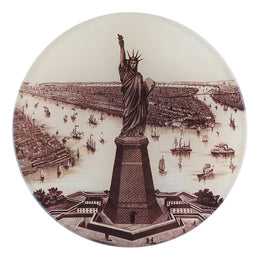
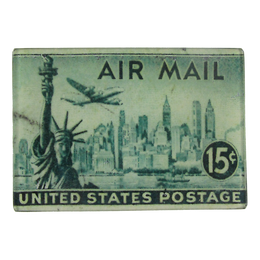
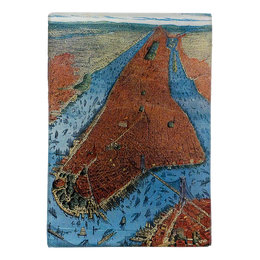
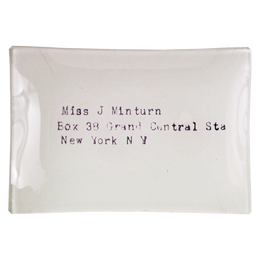
Bartholdi Statue
4" Round Plate
$95.00
Germany, March 2006


Text by Doris Chevron
Photography by Jürgen Frank
JOHN SCISSORHANDS
Old paper becomes style objects: American John Derian cultivates the traditional technique of découpage - with great sensitivity and sense of humor.
Even Madame Tuttle could not have foreseen this.In the late 19th century, the fortune teller received her clients in Salem, Massachusetts, today she posthumously advertises her services in John Derian's New Yorker store on East Second Street.When opening an old book, the designer found her delicate lilac business card and immediately used it for one of his découpage objects.In this way, the 43-year-old gives old drawings, illustrations or writings a new life.The process is not for the impatient: First, the motif is copied onto acid-free, light-resistant paper, then carefully.
From bison to blossoms: In his New York studio, the designer tames true floods of images.He discovers motifs by browsing through magazines, art books, or zoological textbooks below.carefully cut out (French: découpage) and adapted so that the motif also receives curves.Subsequently, plates, vases, bowls, lamp bases or trays are pasted onto the back or inside of the glass body.The paper surface is lacquered several times, ready.Finally, a constantly growing fan base awaits replenishment.In addition to Saks Fifth Avenue and Bergdorf Goodman, Harrods in London as well as Le Bon Marché, Galerie Sentou and the Assouline store in Paris now carry the nostalgic curiosities from John Derian's studio.The origins of the découpage technique lie in the Far East.In the 12th century, Chinese farmers adopted the custom from Siberian nomads of decorating lanterns with colorful scraps.In Versailles, the craft became royal refinement;Marie Antoinette and her ladies-in-waiting embellished small boxes with all sorts of pictures.In 18th-century England, do-it-yourself books like "The Ladies Amusement" were even published.The art of the pointed scissors was also popular in Italy.There, however, it was considered "arte povera" for those who could not afford expensive chinoiseries and enhanced their furniture with floral decorations.
In addition to the precision with which the motifs are cut out, Derian's secret lies in his artistic sense of composition and his delight in the quirky. "I'm the only creative person in our family," he laughs. The youngest of six children, he began crafting still lifes from secondhand prints and found objects from nature as a teenager. His creative talent landed him a job in the Boston shop of Apple Parish Bartlett, the daughter of the famous interior designer Sister Parish. At that time, he was collecting historical illustrations on the side and painting his first pieces of furniture. Then he took a job as a layout artist in the development department of a magazine, cutting out text and photos to arrange them on the pages. The issue never saw market
"EVEN AS A TEENAGER, THE MIX OF NATURE AND CULTURE FASCINATED ME."
John Derian had found his calling.In 1989, he presented his first small decoupage edition: plates with ladybugs and roses, which soon sold brilliantly." From the beginning, there was a painterly element in my designs," he explains.Today, small animals, big game, starfish, and sailing ships cavort on his creations."I hoard motifs until I can assemble them into groups."Although he is now supplied by a network of graphic dealers, he still personally browses flea markets for maps, shop signs, old advertisements, or Op-Art prints that inspire his imagination for new series of images.And of course, Derian can no longer handle the demand alone.Twenty employees work in his studio, which occupies two floors.He meticulously checks the results with a magnifying glass to detect every error.His latest coup is large-scale works à la Fornasetti, whose motifs are composed of many individual objects.A tree made of 16 wall plates, complete with parrots, even achieved film fame and was seen in Woody Allen's "Melinda and Melinda."
Golden Ratio: Even the finest plant structures are no problem for John Derian.The flyer for the devil's toboggan slide below now adorns a key tray.At the very bottom, the designer's decoupage store between Bowery and Second Avenue. Designer Lulu Guinness hung her widely distributed sketch of a brain in her kitchen "for flashes of inspiration during breakfast."John Derian has more than enough of this.He sometimes regrets not having become a painter."I always have to adapt to the available material."But a second career at the easel won't happen that quickly.He just opened another store in the annex for fabrics, antiques, and home accessories.A porcelain and cutlery collection is in the works, and he's also writing a book about visual inspiration.And what's next?Perhaps "Derian," the scent?The artist smiles and fans himself with studio air: "It would probably be called 'Glue'!"

To mark 30 years in New York, John Derian has created a special woven tote bag in collaboration with The Jacksons of London. Handwoven by local artisans in Bangladesh, the bag is made from 100% jute (a strong, low-impact plant that grows quickly and supports the health of the soil). The tote celebrates John’s three decades of inspiration on East 2nd Street in New York City.